Monday, October 5, 2009

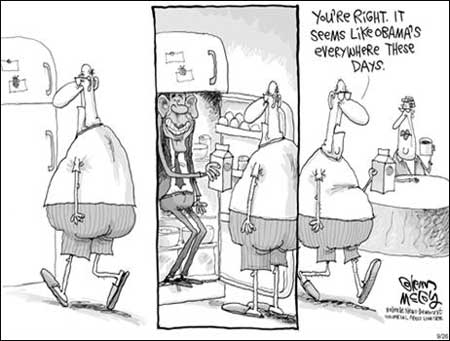
Obama is Everywhere...


Courtesy of Student News Daily

Friday, October 2, 2009

The Life & Worldview of H.G. Wells

Here's a critique of science fiction author H.G. Wells which I found interesting... such a gifted man, but such a Christ-less life...

Persevero,
Scribe

Thursday, October 1, 2009

Created for Work ~ Chapter 10 "Increase"

All of us are probably familiar with the Parable of the Three Talents (Matthew 25:14-29)...
~
Jesus likens the Kingdom of Heaven unto a man who goes on a journey to another country. Before he leaves, he calls his three servants to him, and gives them each a gift: to the first he gives five talents, to the second two talents, and to the third servant one talent...
~
While their master is away, the first two servants use their gifts wisely, earning double the amount they began with. The third servant, however, displays very different character; instead of using his talent to make increase, he does something very foolish - he digs a hole in the ground, plops his gift into it, and buries it...
~
Well, the master of the house finally returns from his travels. The first servant brings him not only the original five talents, but five talents extra. Likewise, the second servant gives his master four talents instead of only two. What about the third servant? Did his money magically sprout in the ground like a seed and yield a crop? Hardly. Instead of returning his lord's money with profit, he returns it just like he received it. There's no gain, no increase. Just that one, single talent. As a result of this slothfulness, the master of the house strips the unprofitable servant of the talent he was given, and orders him to be thrown into "the outer darkness."
~
With this story in mind, we'll look at Chapter 10 of Bob Schultz' Created for Work...
~
Our God is a God of Increase. "In [His] design," Schultz points out, "everything He creates produces something, 'some thirty, and some sixty, and some an hundred' (Mark 4:8). It isn't so much the amount of increase that matters, rather the fact that each part of creation makes increase in proportion to the resources God provides."  
~
In the first place, we should make increase physically. A good and industrious man will take life's challenges head on, and benefit by them. He will strive hard to make progress in whatever work is set before him. He will use whatever talents he has - whether it's landscaping, woodworking, or digging ditches - to make increase. The slothful man will do just the opposite. He'll let his talents lie cold and unused. He'll make zero progress, and shirk the problems of life. To such a man, "increase" is an unknown word. 
~
We should also make increase in our spiritual lives as well. A Christian who seldom reads the Scriptures, acts like the world, and takes his faith lightly, is of no use to the cause of Christ except to serve as a warning to others. Our goal should be to bring glory to God, edify fellow believers, and bring the unsaved to the salvation found in Christ. Our words and actions should further the Kingdom of God, not injure it's cause.
~
When Christ returns, will He find that we have been diligent and made increase with the tools - physical and spiritual - which He provided? Or will He find that we have buried them in the ground?
~
Schultz says in conclusion, "Don't sit around bored with life. Look around you. Meager as they might be, find your resources, add them to your labor and make some increase today." 
~
"I have planted, Apollos watered; but God gave the increase. So then neither is he that planteth anything, neither he that watereth; but God that giveth the increase." 
~ 1 Corinthians 3:6-7


* * *
Persevero,
Scribe 

Get your own copy of Created for Work here

Wednesday, September 30, 2009

"The Charge of the Light Brigade"

"The Charge of the Light Brigade" is based on an actual event that occured in the Battle of Balaclava (1854) during the Crimean War. For a greater appreciation of this poem, read the story here...
* * *
Half a league, half a league,
Half a league onward,
All in the valley of Death
Rode the six hundred.
"Forward, the Light Brigade!
Charge for the guns!" he said:
Into the valley of Death
Rode the six hundred.
~
"Forward, the Light Brigade!"
Was there a man dismay'd?
Not tho' the soldier knew
Someone had blundered:
Their's not to make reply,
Their's not to reason why,
Their's but to do or die:
Into the valley of Death
Rode the six hundred.
~
Cannon to the right of them,
Cannon to the left of them,
Cannon in front of them
Volley'd and thunder'd;
Storm'd at with shot and shell,
Boldly they rode and well,
Into the jaws of Death,
Into the mouth of Hell
Rode the six hundred.
~
Flash'd all their sabres bare,
Flash'd as they turn'd in air,
Sabring the gunners there,
Charging an army, while
All the world wondered:
Plunged in the battery smoke,
Right thro' the line they broke;
Cossack and Russian
Reel'd from the sabre stroke
Shatter'd and sunder'd.
Then they rode back, but not
Not the six hundred.
~
Cannon to the right of them,
Cannon to the left of them,
Cannon in front of them
Volley'd and thunder'd;
Storm'd at with shot and shell,
While horse and hero fell,
They that had fought so well
Came thro' the jaws of Death
Back from the mouth of Hell,
All that was left of them,
Left of six hundred.
~
When can their glory fade?
O the wild charge they made!
All the world wondered.
Honor the charge they made,
Honor the Light Brigade,
Noble six hundred.

~ Alfred Lord Tennyson


* * *
Persevero,
Scribe